


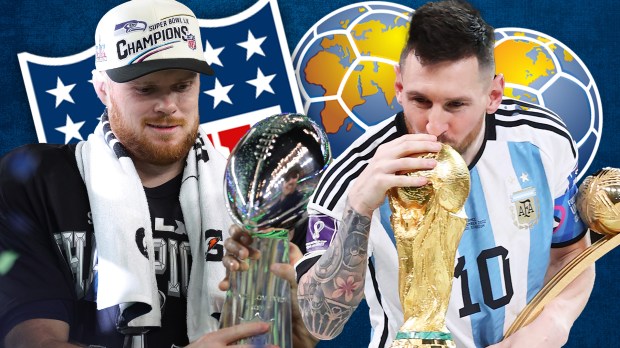
FootyExperts.com – For decades, the Super Bowl has stood as an unassailable titan in the American sporting landscape. A cultural phenomenon, a national holiday, and a commercial juggernaut, it represents the pinnacle of American football. Yet, beneath the surface of gridiron glory, a quiet revolution has been brewing, one that suggests the global spectacle of the FIFA World Cup is not just gaining ground, but is on an inevitable trajectory to eclipse the Super Bowl in the hearts and minds of a new generation of American sports fans. It’s time for real football – the beautiful game – to take its rightful place.
The argument isn’t about diminishing the Super Bowl’s immense appeal. It’s about recognizing the fundamental differences in scale, cultural depth, and growth trajectory. The Super Bowl is a magnificent, singular event, a culmination of a domestic league. The World Cup, however, is a month-long global carnival, a quadrennial celebration of national pride, skill, and passion that transcends borders, languages, and demographics. It is, quite simply, the biggest sporting event on the planet, and its gravitational pull is becoming irresistible even in a nation traditionally devoted to its own unique brand of ‘football.’
Consider the demographic shifts within the United States. A diverse and increasingly globalized population brings with it a natural affinity for soccer. Immigrant communities from Europe, Latin America, Africa, and Asia carry their love for the sport with them, passing it down to their children. This organic growth is complemented by a massive surge in youth participation. Soccer is now one of the most played sports among American children, fostering a grassroots connection that will inevitably translate into a larger, more engaged adult fanbase. These young players are growing up watching Lionel Messi and Cristiano Ronaldo, not just Patrick Mahomes.
Also Read
The Major League Soccer (MLS) has also played a crucial role. While still maturing, the league has seen significant expansion, improved quality, and increased attendance. The arrival of global superstars like David Beckham, Zlatan Ibrahimović, and most recently, Lionel Messi, has injected unprecedented excitement and legitimacy. These players don’t just bring their talent; they bring global eyeballs and a heightened sense of the sport’s international prestige. The MLS is building a foundation, creating local heroes and rivalries that mirror the passion seen in established European leagues.
Beyond domestic growth, the American appetite for international football is insatiable. Premier League matches are routinely broadcast to millions, Champions League nights draw significant viewership, and major international tournaments like the Euros and Copa América capture widespread attention. This constant exposure to the highest levels of the sport cultivates a sophisticated fanbase, one that appreciates the tactical nuances, the individual brilliance, and the sheer drama that only soccer can deliver.
But the true game-changer is the World Cup itself, particularly with the 2026 edition co-hosted by the United States, Canada, and Mexico. This isn’t just another tournament; it’s an unprecedented opportunity to showcase the sport on home soil to an entire continent. The sheer scale of the event – 48 teams, 104 matches, spread across multiple iconic cities – will generate an economic and cultural impact far exceeding any single Super Bowl. It will be a month-long festival, a continuous narrative of triumphs and heartbreaks, uniting communities and captivating the nation in a way that a four-hour event simply cannot.
The World Cup offers something the Super Bowl, for all its grandeur, cannot: a direct, emotional connection to global identity. When the USMNT plays, the nation rallies behind them, but when Brazil, Argentina, Germany, or Italy play, their respective diasporas in the US come alive, creating vibrant pockets of celebration and rivalry across American cities. This mosaic of support adds a unique, multicultural dimension to the World Cup experience that is inherently more expansive than the Super Bowl’s largely domestic focus.
While the Super Bowl remains a powerful cultural touchstone, its appeal is largely confined to North America. The World Cup, by its very nature, is a universal language, a shared human experience. As America continues to embrace its global identity, its sporting preferences are evolving. The continuous narrative, the global stakes, the sheer volume of high-stakes matches, and the unparalleled cultural fusion of the World Cup are proving to be a more compelling, enduring draw. The Super Bowl is a fantastic party, but the World Cup is a global movement, and in the long run, movements tend to outlast parties. The time for real football to reign supreme in the US is not coming; it is already here, and 2026 will be its coronation.
Featured Image Source: talksport.com